
Yacht profile
RONA, 1895
From Victorian yacht to sail training legend.
- Name
- RONA
- Built
- 1895
- Builder
- Stow & Son
- Current reported LOA
- 23.8 m
- Original name
- AURA
Rona has survived more than 130 years, but not unchanged. Launched in Shoreham in 1895 as the gaff yawl Aura, she survived a devastating grounding, the Second World War, a fundamental postwar reconstruction and more than three decades training young sailors at sea.
Record
Yacht at a glance
- Current name
- RONASources: NHS-UK
- Documented
- Original name
- AURASources: NHS-UK
- Documented
- Possible former name
- ALVERSources: Shoreham
- Secondary source
- Builder
- Stow & Son / Stow & Sons, Shoreham, EnglandSources: NHS-UK, Shoreham
- Documented
- Designer
- H. T. StowSources: Shoreham
- Secondary source
- Built
- 1895Sources: NHS-UK
- Documented
- Original reported length
- approx. 21.95 m / 72 ft
- Secondary source
- Current reported length
- 23.8 m / 78 ftSources: Berthon
- Reported by specialist source
- Current reported volume
- 70 GT in SuperYacht Times dataSources: SYT
- Conflict / unresolved
- Historic register volume
- 84 GT in National Historic Ships dataSources: NHS-UK
- Conflict / unresolved
- Current accommodation listing
- 11 berths in 3 cabinsSources: Berthon
- Reported by specialist source
- Current rig
- KetchSources: Berthon
- Reported by specialist source
- Original rig
- Gaff-rigged yawl
- Secondary source
- Current location in sales material
- Batam, IndonesiaSources: Berthon
- Reported by specialist source
Provenance note: differing dimensions and tonnage figures may reflect rebuilds, historical measurement conventions and later reporting. They are held apart here rather than silently merged into a single set of numbers.
Provenance confidence
- Documented
- Reported by specialist source
- Secondary source
- Conflict / unresolved
- Requires verification
Photographic record
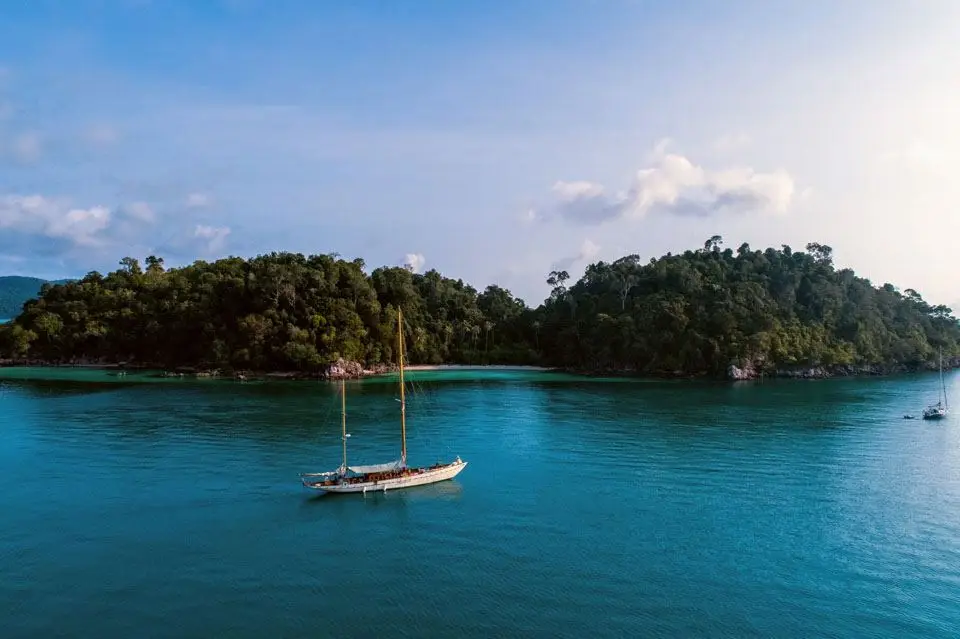
Rona in her present configuration
Images of the vessel as she appears today. They record the current configuration only, and are not evidence for the extent of surviving 1895 material.
Exterior — 9 photographs
Interior — 6 photographs
Photographs supplied to the archive. Dates, locations and photographer credits are not yet established; rights confirmation is required before publication.
General arrangement
Reported deck and accommodation layout
A line drawing showing the hull profile in plan, with the accommodation arranged between the forward and aft ends: forecastle and machinery space forward, a central saloon and adjoining cabins amidships, companionway and heads to either side, and further cabins and stowage aft. The long overhangs at bow and stern are shown as unaccommodated hull volume.

Undated and uncredited drawing, apparently from current marketing material. It represents the present configuration only and is not evidence for the 1895 or postwar arrangements.
1895
Origins
Rona was launched as AURA by Stow & Sons at Shoreham in 1895: a gaff-rigged yawl of approximately 72 ft, with a clipper bow and a long bowsprit, in the idiom of late-Victorian yacht building on the Sussex coast.
H. T. Stow is attributed as designer in secondary historical material. That attribution should be checked against Lloyd’s Register or original yard records before it is published as documented fact.
Sources: NHS-UK, ShorehamDesigner attribution and original dimensions currently rest on secondary sources.
Identity
Early identity and name history
AURAFrom 1895
Original name at launch in 1895.
Sources: NHS-UKDocumentedALVER
Appears in secondary Stow-related historical material. Position in the chronology, and whether the name applied to this hull at all, is unresolved.
Sources: ShorehamSecondary sourceRONA
Later established identity, under which the vessel is registered and known today.
Sources: NHS-UK, RSPDocumented
Methodology note: Historical Yachts does not treat repeated online claims as proof of a name change without a registry, yard, archive or contemporary documentary source.
1903
Registration and motorisation
National Historic Ships reports re-registration in Liverpool in 1903, when an engine was first fitted — an early instance of auxiliary power in a hull built as a pure sailing yacht eight years earlier.
1937
The grounding
Specialist sales-history material reports that Rona stranded during a storm in the West Country — identified by Berthon as Exmouth — severely damaging the stem.
She was subsequently taken to Morgan Giles at Teignmouth, the yard that would remain part of her story through the following decade. The stem damage matters for provenance: it is the first documented point at which major structure forward is likely to have been renewed.
Sources: BerthonExact location, date and extent of damage are specialist-source reported and worth verifying against contemporary press, lifeboat records and yard books.
1939–45
War years and Morgan Giles
She reportedly remained at Morgan Giles through the Second World War. Sales-history material claims her lead keel was concealed for the duration — a compelling anecdote of the kind that circulates widely in classic-yacht history, and one that should be independently verified before it is presented as documented fact.
Postwar references place her under Ministry of Defence control. That is not the same claim as Royal Navy ownership, and Historical Yachts does not describe it as such unless a primary source confirms it.
Postwar
The defining change
After the war she was sold to Captain Linsay Smith MBE and underwent a fundamental rebuild — not a refit, but a reworking of the hull’s length, profile and rig.
- Approximately 6 ft of additional length
- Original clipper bow replaced by the present bow form
- Rig changed toward the present ketch configuration
- Returned to sailing by around 1951
“How much of the yacht launched in 1895 is still Rona?”
Historical Yachts treats this not as a negative but as the central provenance question of the vessel. Physical authenticity, continuity of identity, surviving original structure, design intent and later historical significance are separate measures, and a yacht can score very differently on each. Reconstruction is part of her record, not an erasure of it.
1960
Royal Navy training loan
Specialist historical material reports that she was loaned to a Royal Navy training unit in 1960 and took part in a Tall Ships Race that year.
Loan and training use is not the same as proven Royal Navy ownership. The distinction is carried through this profile deliberately.
1961–1993
Lord Amory and the London Sailing Project
Lord Amory acquired Rona in 1961 for the London Sailing Project. She became the project’s central sail-training vessel and served it for thirty-two years, taking young people to sea to learn seamanship, responsibility and the ordinary discipline of working a watch with others.
This is the best-documented period of her life. The organisation, now the Rona Sailing Project, maintains its own history pages and an archive recording Tall Ships participation, voyages and the project’s development. She was sold out of project service in September 1993.
Sources: RSP, RSP ArchiveConfidence is higher here because the operating organisation documents its own history and retains an archive.
After 1993
Return to private ownership and restoration
After 1993 Rona returned to private ownership and underwent extensive restoration and conversion back to private-yacht use, including a major restoration programme reported through the 1990s.
Details of that programme currently derive from brokerage material rather than yard records. Individual items — bulwark and joinery work, deck work, accommodation changes — are recorded here as reported, pending invoices, survey reports or yard documentation.
Material history
What remains from 1895?
This is a research framework, not an answer. No percentage of original material is claimed, because no public source supports one. Each line records what is known, reported or simply not established.
Hull structure
Known altered
Reported lengthening by approximately 6 ft during the postwar reconstruction implies substantial structural intervention. Extent of surviving 1895 fabric is not established in public sources.
Sources: BerthonKeel
Unknown from public sources
Sales-history material refers to a lead keel during the war years. Whether the present keel is that casting is not documented publicly.
Sources: BerthonFrames
Requires survey or yard documentation
No public source establishes how many original frames remain or when renewals were carried out.
Deck beams
Reported renewed
Oak deck beam renewals reported in the 1980s. Scope and proportion not stated in public sources.
Sources: BerthonDeck structure
Reported renewed
Teak deck work reported; doghouse replacement reported in 1989.
Sources: BerthonJoinery
Reported renewed
Bulwark and joinery work reported in the 1990s restoration period.
Sources: BerthonRig
Known altered
Original gaff yawl rig changed toward the present ketch configuration during the postwar rebuild.
Sources: BerthonBow geometry
Known altered
The original clipper bow was replaced by the present bow form in the postwar reconstruction.
Sources: BerthonMachinery
Known altered
An engine is reported as first fitted around the 1903 Liverpool re-registration; machinery has been replaced and rebuilt since, most recently within reported maintenance history.
Sources: NHS-UK, BerthonInterior layout
Known altered
Sail-training service and the later conversion back to private-yacht use both imply layout change. Current listing describes 11 berths in 3 cabins.
Sources: Berthon2017 onward
Modern refit timeline
Reported maintenance history from current or recent sales material. These are listing statements, not independently verified yard records, and the year attributed to each item may reflect the listing’s own summary rather than an invoice date.
- 2017Reported acquisition by current or recent owner; maintenance programme resumed.Sources: Berthon
- 2018Mast work reported.Sources: Berthon
- 2019Hydraulics work and AIS / navigation electronics reported.Sources: Berthon
- 2020Generator rebuild and hot-water system reported.Sources: Berthon
- 2021Tender and electric toilets reported.Sources: Berthon
- 2022Pump replacements and head / shower work reported.Sources: Berthon
- 2023Exterior paint reported.Sources: Berthon
Unresolved
Conflicts in the public record
| Field | Reading A | Reading B | Note |
|---|---|---|---|
| Length | approx. 21.95 m (historic) | 23.8 m (current) | Consistent with reported postwar lengthening, but also with differing measurement conventions.Sources: NHS-UK, Berthon |
| Volume | 84 GT (historic register reference) | 70 GT (current market database) | Tonnage rules have changed repeatedly; the two figures are not directly comparable without their measurement basis.Sources: NHS-UK, SYT |
| Accommodation | “11 guests” | “11 berths in 3 cabins” | Not necessarily equivalent. Berth count and guest capacity are different claims.Sources: Berthon, SYT |
| Former name ALVER | Appears in secondary source | Absent from primary registers consulted to date | Not yet primary-verified; retained in the record as an open question.Sources: Shoreham |
| Royal Navy ownership | Commonly implied in some listings | MoD involvement and later loan to a Royal Navy training unit | Available evidence better supports the second reading. Ownership is not established.Sources: Berthon |
| Current asking price | Differing figures across databases | Differing currencies and dates | May reflect stale listings or currency conversion rather than a price change.Sources: Berthon, SYT |
Historical Yachts preserves source conflicts until they can be resolved. A cleaner story is not more valuable than an accurate one.
Chronology
Timeline
- 1895Launched as AURA by Stow & Sons, Shoreham.Sources: NHS-UKDocumented
- 1903Re-registration in Liverpool reported, when an engine was first fitted.Sources: NHS-UKDocumented
- 1937Grounding in a West Country storm; taken to Morgan Giles, Teignmouth.Sources: BerthonReported by specialist source
- 1939–45War years reportedly spent at Morgan Giles; later references place her under Ministry of Defence control.Sources: BerthonRequires verification
- PostwarSold to Captain Linsay Smith MBE; fundamental reconstruction.Sources: BerthonReported by specialist source
- c. 1951Returned to sailing after the major rebuild.Sources: BerthonReported by specialist source
- 1960Loaned to a Royal Navy training unit; Tall Ships Race participation reported.Sources: BerthonReported by specialist source
- 1961Acquired by Lord Amory for the London Sailing Project.Sources: RSPDocumented
- 1961–1993Sail-training service; 32 years with the project.Sources: RSP, RSP ArchiveDocumented
- 1993Sold out of project service in September.Sources: RSPDocumented
- 1990sReturn to private ownership and extensive restoration / conversion.Sources: BerthonReported by specialist source
- 2017Reported acquisition by current or recent owner.Secondary source
- 2020sContinuing reported maintenance; offered for sale at the time of source review.Sources: Berthon, SYTReported by specialist source
Current status
Where is Rona today?
At the time of the current source review, brokerage material places Rona in Batam, Indonesia, and offered for sale.
No asking price is recorded here as a fixed fact. Published figures differ across databases and may reflect stale listings or currency conversion; any price cited in future should carry the source observed and the date of observation. Market listings become out of date quickly and are not a statement about the vessel’s history.
Public sources observed: 30 August 2026.
Significance
Why Rona matters
Victorian survival
A hull launched in 1895 that is still sailing is rare in itself, and rarer still with a traceable line of yards, owners and registrations behind it.
Reconstruction as history
The postwar rebuild changed her length, bow and rig. That is part of her identity rather than simply a loss of originality, and it is recorded as such.
Documented social history
Thirty-two years of sail training gave her a social record that most private yachts never acquire, held in an archive rather than in anecdote.
References
Source register
Registry / heritage registerNHS-UK · Primary
National Historic Ships UK — RONA register entryhttps://www.nationalhistoricships.org.uk/register/735/rona
Institutional project historyRSP · Primary
Rona Sailing Project — historyhttps://www.ronasailingproject.org.uk/pages/history
ArchiveRSP Archive · Primary
Rona Sailing Project archivehttps://rsparchive.org.uk/
Specialist brokerage historyBerthon · Secondary
Berthon International — RONA sales history / listinghttps://www.berthoninternational.com/yacht-sales-brokerage/yachts-for-sale/78-custom-stow-sons-classic-ketch-rona/Sales material. Historical statements here are treated as reported until verified against yard, registry or archive records.
Secondary local maritime historyShoreham · Secondary
Shoreham by Sea — Stow & Suter Yachtshttps://shorehambysea.com/stow-suter-yachts/
Market databaseSYT · Market
SuperYacht Times — RONA profilehttps://www.superyachttimes.com/yachts/rona/overview
Primary-source follow-up required
- Lloyd’s Register entries for 1895 onward
- Original registration and re-registration records
- Morgan Giles yard records, Teignmouth
- Ministry of Defence and Royal Navy records
- Yard invoices for the postwar reconstruction
- Restoration documentation from the 1990s onward
Research status
Preliminary public-source provenance review
This profile is a working historical record, not a completed provenance certification. Primary registers, yard archives and restoration records may materially refine the chronology.
Public-source review date: 30 August 2026. This is the date the public record was reviewed, not the date of a vessel survey.
Commission a Full Provenance FileRelated
Classic sailing yachts
Creole
1927 three-masted schooner; long ownership chain.
Profile in preparation
Endeavour
1934 J-Class; rebuilt in the 1980s.
Profile in preparation
Shamrock V
1930 J-Class; surviving America’s Cup challenger.
Profile in preparation
Velsheda
1933 J-Class; restored to sail.
Profile in preparation
Eilean
1936 Bermudan ketch; documented restoration.
Profile in preparation
Sea Cloud
1931 four-masted barque; wartime service.
Profile in preparation